
Learn the EB-2 PERM steps to obtain a Green Card: labor certification, I-140, adjustment of status or consular process and timeframes.
Share this article on:

For some professionals, obtaining permanent residency in the United States through employment can be an alternative for developing a long-term professional and immigration project. However, the route EB-2 PERM It involves several stages and requires the participation of different authorities.
At AsisVisa, we understand that understanding what happens after finding a potential employer willing to sponsor a Green Card can be complex. Therefore, we explain below the main steps in this process and some of the factors that can influence its timeline.
The first step of the EB-2 PERM route is the Permanent work certification (PERM) before the Department of Labor (DOL).
This process is the responsibility of the U.S. employer. Generally speaking, the DOL must determine that there are not enough able, willing, qualified, and available U.S. workers to fill the job opportunity and that hiring the foreign worker will not adversely affect the wages and working conditions of U.S. workers in similar positions.
To do this, the employer must meet various requirements, which may include:
The date the DOL receives the labor certification request can establish the priority date of the case. If the certification is approved, it is valid for 180 days to be used in the next stage before USCIS.
Once the labor certification is approved, the employer can submit it to US Citizenship and Immigration Services (USCIS) he Form I-140, Immigrant Petition for Alien Workers.
At this stage, USCIS evaluates the employment-based immigrant petition and the documentation that proves that the worker and the position meet the requirements of the corresponding category.
The EB-2 classification includes, among others, certain professionals with advanced degrees or their equivalent, as well as individuals with exceptional abilities in the sciences, arts, or business. The PERM pathway also requires a permanent job offer and a sponsoring employer.
The employer must submit Form I-140 along with the approved labor certification and required documentation. The PERM certification must be submitted within its 180-day validity period.
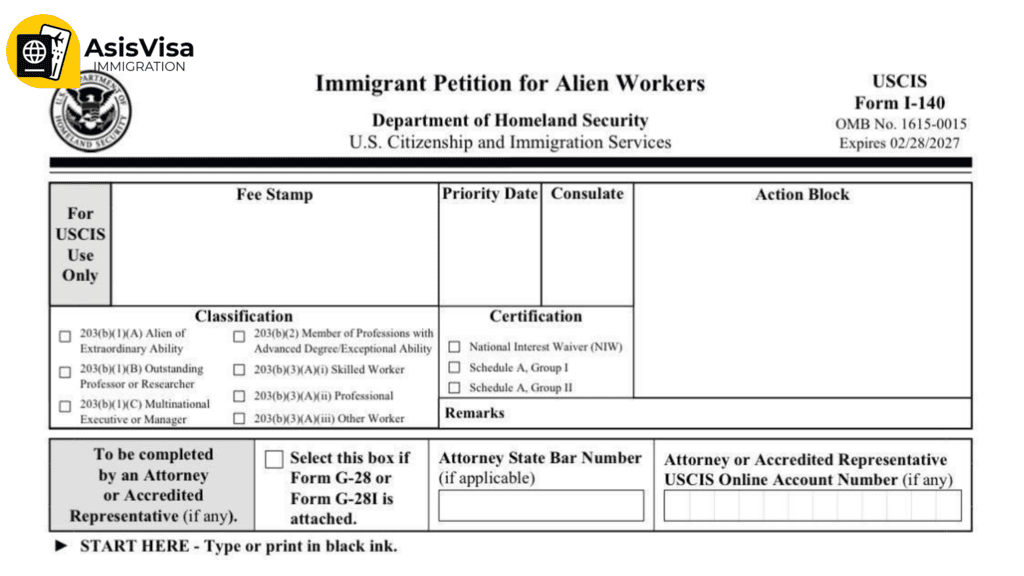
[VISUAL REFERENCE: USCIS Form I-140.]
The final stage depends, among other factors, on where the beneficiary is located and the availability of an immigrant visa.
Status Adjustment
If the person is in the United States and meets the requirements to do so, they can apply for the Adjustment of Status using Form I-485.
In employment-based immigration categories, visa availability is limited. Therefore, the beneficiary should review their priority date and consult the Visa Bulletin to determine when you can file the I-485.
Consular Process
If the beneficiary must complete the process from outside the United States, the case must continue through consular processing.
This route involves the National Visa Center (NVC) and subsequently to the corresponding embassy or consulate. Depending on the circumstances of the case, steps may include the submission of civil documents, the immigrant visa application form, the medical examination, and the consular interview.
There is no single time to complete the entire process.
The duration depends on the different stages: the processing of the PERM certification with the DOL, the processing of the I-140 with USCIS, and subsequently, the adjustment of status or consular processing. The availability of immigrant visas is also a factor.
Therefore, the Visa Bulletin This is especially important for EB-2 categories. The Department of State publishes this bulletin every month and establishes priority dates that determine visa availability in different categories and countries.
The EB-2 PERM process involves several stages, requirements, and immigration authorities. From the employer's labor certification with the Department of Labor to the filing of Form I-140 with USCIS and the final stage of obtaining permanent residency, each step must be planned according to the specifics of each case.
In addition, factors such as the beneficiary's academic background and professional experience, job requirements, priority date, cargo country, and visa availability may influence the development of the process.
If you are considering this alternative and have a potential employer willing to sponsor you, AsisVisa can help you understand the stages, requirements, and conditions that must be evaluated before starting the process.
With a proper evaluation, it is possible to better understand if the EB-2 PERM can be a suitable pathway for your professional profile and your immigration goals in the United States.
Discover your immigration options in the United States with our artificial intelligence tool. Analyze your resume (CV or résumé) and identify the visa categories for which you may be eligible, along with a percentage probability of your chances of success based on your professional profile.

EB-2 NIW Visa: The Green Card for professionals who don't need an employer sponsor. Learn more...
Change of status and paths to a Green Card: how to build an immigration strategy Learn more...

Duration of Status: What does the pause in the new rule mean for F-1 students and...