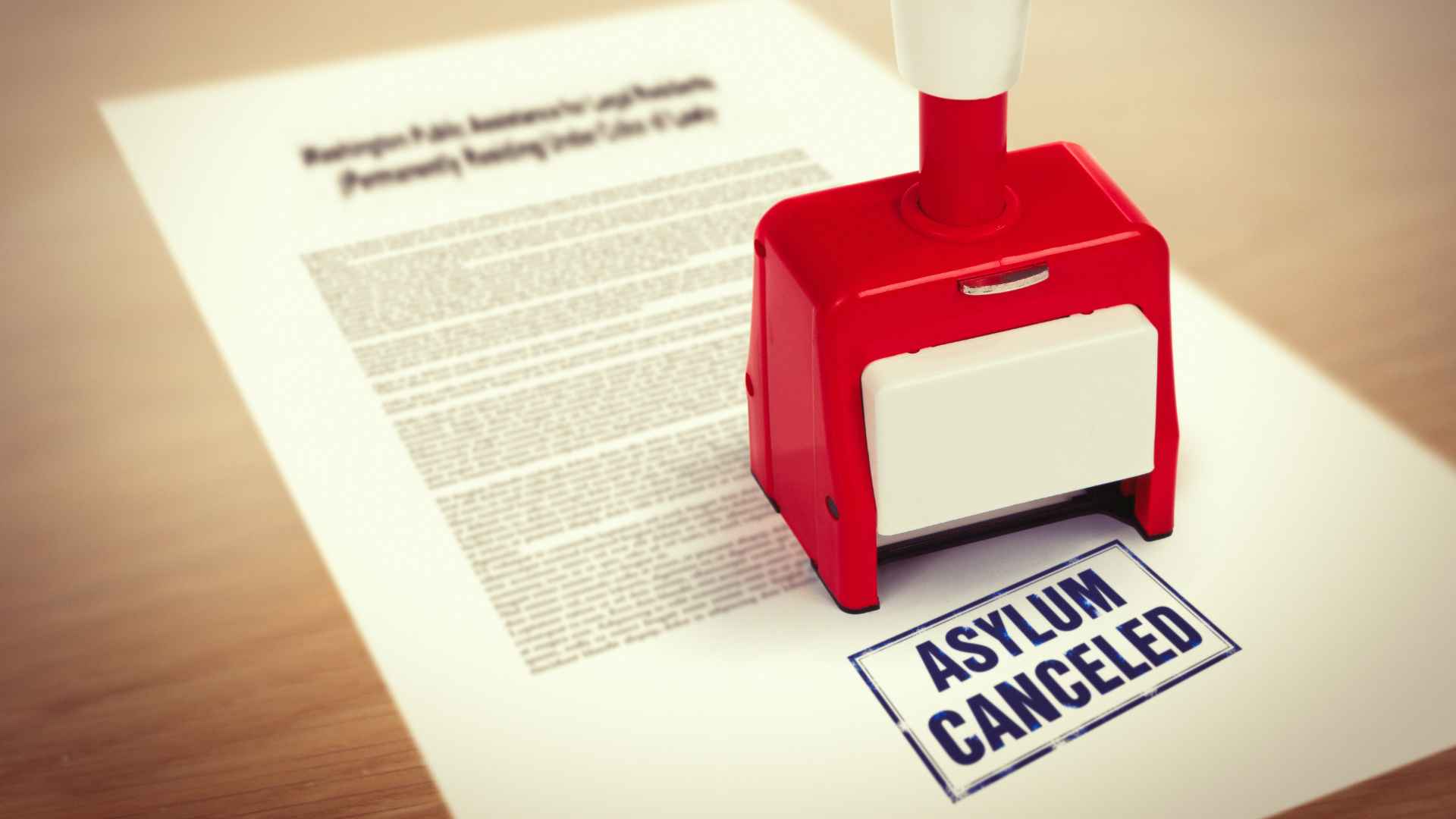
The United States removes restrictions on processing asylum seekers at the border

Currently, the United States government, which maintains the deportation of migrants under public health reasons, has ended the limitations on the number of asylum seekers who can be processed at border crossings due to a memorandum issued by Troy Miller, acting director of the Customs and Border Protection Office.

This memorandum seeks to end the Migrant Protection Protocols (MMP) program established by the administration of former President Donald Trump, under which foreigners who arrive at the southern border seeking asylum are returned to Mexico and Central America while awaiting a hearing before immigration courts.

In the memorandum, Troy Miller, acting director of Customs and Border Protection (CBP), repealed several of the measures adopted by the Trump Administration and ruled an expansion of the processing of applications that are feasible to process in terms of operation.

Troy Miller's memorandum is reaffirmed by one issued on October 29 by Homeland Security Secretary Alejandro Mayorkas, in which he notified the agencies involved in migration of his decision to end the MPP program "as soon as possible.".

The impact of the memorandum is unclear because President Joe Biden's administration maintains the use of Title 42, implemented by former President Donald Trump since March 2020, which allows for the free deportation of migrants whom border authorities consider a threat to public health.

Higher likelihood of asylum denial for Haitians by the United States

Gibbens Revolus, his wife Lugrid, and their 2-year-old son Diego have had to experience firsthand the contempt, racism, and struggles of many Haitian immigrants as they undertake the difficult journey to the border between the United States and Mexico from Chile.

Gibbens Revolus, his wife Lugrid, and their 2-year-old son Diego have had to experience firsthand the contempt, racism, and struggles of many Haitian immigrants as they embarked on the difficult journey to the border between the United States and Mexico from Chile, only to end up like around 15,000 other Haitians in unsanitary conditions at the International Bridge in Del Rio, Texas, awaiting asylum.

Revolus has sought opportunities since his country entered a growing crisis due to the aftermath of the devastating earthquake, political instability due to the death of President Jovenel Moïse in July, as well as a wave of gang violence and uncontrollable kidnappings.

Gibbens embarked on his journey from Haiti to Chile, where he found work in a butcher shop, stocking refrigerators and shelves, barely enough to cover his basic needs. However, attitudes toward Haitians soon changed. «Two coworkers tried to stab me,» says Revolus, who was in Chile on a work visa.

Feeling that growing pressure in Chile, he decided to begin his journey to the US border at the beginning of this year, where, according to him, they lived through a hell that took them 3 months of travel by bus, several days walking and crossing from Colombia to Panama in a crowded boat, only to end up being deported by the border patrol on September 27.

“We were just looking for a better life, but they turned us away” … “After each of the decades of US meddling in Haiti’s affairs, I really believed I would be allowed to ask for asylum at the border,” Gibbens says, speaking on his cell phone from Port-au-Prince.

Now Revolus and his family, like many other Haitian immigrants, remain back in a territory where the rule of law seems to have collapsed.

Increase in “in absentia” deportation orders against immigrants

Around 173 immigrants received deportation orders between August and September 2021, which is 9 times more than the 20 orders issued between January and July of this year, according to court data.

Between January and May 2021, there were only one or two deportation orders issued in absentia per month, while in June, 14 were registered in these courts. However, in August there were 63 and in September 110 deportation orders. The San Francisco Chronicle warns that the figures for October may be similar.

These numbers have increased considerably because immigration judges in San Francisco, California, have increased the number of "in absentia" deportation orders issued against immigrants who failed to appear for their hearings, the Chronicle newspaper warned on Monday.

These decisions have generated several criticisms from immigrant advocates because deportation orders are being imposed on immigrants who did not receive court notifications because they were returned and categorized by the postal service as undeliverable, in addition to warning that the courts were notifying immigrants of hearings by sending mail to incorrect addresses.

According to the Transactional Records Access Clearinghouse (TRAC) at Syracuse University, the figures for fiscal year 2021 ended with a backlog of 1,457,615 cases awaiting resolution in U.S. immigration courts.

However, immigration attorney Fernando Romo told EFE that in some cases these deportation orders issued in absentia can be challenged in court. Among the grounds for reopening the case is the argument that the immigrant was never notified by the court.

Some detained migrants will receive minimum wage in the United States

A federal jury determined that The GEO Group, a for-profit detention center, must pay a minimum wage to detained immigrants who perform jobs such as cooking or cleaning within its facilities in Washington state.

“This multibillion-dollar corporation illegally exploited the people it detained to line its pockets,” Washington Attorney General Bob Ferguson said in an emailed statement. «Today’s victory sends a clear message: Washington will not tolerate corporations enriching themselves by violating people’s rights.».

The jury will determine how much money is owed to the detained immigrants who worked at the facility, a sum presumed to reach millions of dollars. Federal Judge Robert Bryan will decide how much The Geo Group must pay the state of Washington for the charge of unjust enrichment at the expense of the detainees.

The detention center being sued argued that the inmates were not employees under Washington's Minimum Wage Law. It added that even if they were, it would be illegal and discriminatory for Washington to require GEO to pay minimum wage to inmates working in its own prisons or other detention facilities.

Washington appears to be the first state to sue a private detention contractor for failing to pay wages to detained immigrants. However, similar lawsuits have already been filed by detained immigrants in other states, including New Mexico, Colorado, and California, seeking to compel GEO and another major private detention company, CoreCivic, to pay detainees minimum wage.

This news story was created from AP News

US immigration advocates abandon dialogue with the Biden administration

Immigrant advocates in the United States walked out of a virtual meeting with White House officials in protest against border policies enacted during the Trump administration against undocumented immigrants and maintained by the Biden administration. 

The activists stated that they could no longer “enter into these conversations with a good conscience” after witnessing how President Joe Biden’s administration “plays politics with human lives.” 

The meeting and subsequent departure of the defenders was prompted by the Biden administration's plans to reinstate the Migrant Protection Protocols (MPP), also known as Remain in Mexico, next month. This program seeks to force asylum seekers to wait on the other side of the southern border (Mexico) for their hearings. 

A significant part of the activists' frustration and concern lies in Washington's continued use and defense of Title 42, a public health order that was first used under the Trump administration as an excuse to expel migrants amid the Covid-19 pandemic.

According to analysts, the White House is trying to revive the immigration proposal put forward at the beginning of the term, which enacted more humane immigration laws, an idea that has become blurred with the strict measures implemented by the Biden administration. 

Latinos in Wisconsin stage strike against immigration reform

Thousands of people marched on Monday, October 11, Columbus Day in the United States. The march began on the south side of Milwaukee and proceeded to the Federal Courthouse as part of the statewide "Day Without Latinos and Immigrants" strike.

People like Ramiro Castillo, a Latino immigrant who joined the strike against immigration reform, understand what it's like to live in the shadows, arriving in the United States from Mexico at 18 and starting to work for little money, receiving a paycheck for $500 after working 80 hours a week, that is, approximately 11 to 12 hours a day.  

Ramiro, now the owner of a business called Castillo Landscaping, decided to close on the day of the march to support his community in demanding immigration reform. 

The strike was organized after a U.S. Senate member gave his opinion on the reform, stating that immigration-related reforms could not be included in the Build Back Better reconciliation budget bill awaiting Congress. 

«We demonstrated great power by participating in a day without Latinos,» Castillo said in Spanish. The mobilization culminated in a rally at the Federal Courthouse, where teachers, farmworkers, and allies spoke about their experiences as immigrants in the country. 

More mobilizations are planned in other states leading up to the October 31 deadline when Democrats will vote on the bill. 

The United States suspends raids on undocumented immigrants in workplaces

According to a memorandum issued on October 12 by Homeland Security Secretary Alejandro Mayorkas, federal immigration agents will end mass workplace arrests of immigrant employees suspected of living in the United States without legal permission. 

Now, instead of searching for undocumented immigrants, they seek to shift the focus to “unscrupulous employers who exploit the vulnerability of undocumented workers” and will emphasize the fight against worker abuse, including poor wages, unsafe working conditions, and human trafficking.

The memorandum specifies that within two months, the heads of Immigration and Customs Enforcement, Citizenship and Immigration Services, and Customs and Border Protection must develop a plan that increases penalties for employers, encourages workers to report unscrupulous practices, and coordinates with other agencies such as the Department of Labor. 

These types of raids were defended during the administration of former President Trump and other Republican presidents as strong deterrents against illegal immigration, while workers denounced them as unfair and discriminatory. A clear example of this was when 680 Latino workers were arrested at chicken plants run by organizations like Koch Foods, based in Illinois.  

Nadia Marín Molina, executive director of the National Network of Day Laborer Organizations, stated: “It is time for the U.S. Department of Homeland Security to stop allowing employers to use the threat of deportation as a tool to facilitate exploitation and evade accountability… Immigrant workers kept the lights on in this country during a pandemic, and the government essentially told them they should work themselves to death without basic rights so that others could live.”.

Testimony from a student, family, and lawyer about the struggles to immigrate to the United States

TJ is a Hindu who came to the United States in search of opportunity in 2013 along with his parents Sundhir and Punita, who were proud when they received the news that their son TJ would be moving into the freshman dorms at UC Berkeley, however, this news was overshadowed by a problem with the United States immigration system. 

Sudhir works for a private consulting firm and holds an H1B visa, while his wife, Punita, and son, TJ, hold H4 visas, which are issued for dependent relatives who are not permitted to work in the United States. TJ is a junior chemical engineering student at CAL and needs an internship to gain more knowledge that will make him more competitive with his classmates and help him secure a job after graduation. 

TJ needs his H4 visa converted to an F1 visa. The family filed the paperwork for the change in July 2020. «A process that usually takes about six to seven months is still underway right now,» Sudhir said. «So, it’s been over a year.» «Unfortunately, this happens to a lot of people, and I think it’s been happening more in recent years,» said Ann Block, senior special projects attorney at the Immigrant Legal Resource Center (ILRC). 

In addition to the delays, TJ's case has also been further hampered by existing immigration delays due to Covid-19. However, the situation is further aggravated because TJ risks losing his H4 visa, meaning he cannot remain in the U.S. once he turns 21, and he is currently 20.

«If he gets older, then he needs an alternative visa like the F1, which is already being processed, or he has to leave the country,» Sudhir said. If TJ is forced to leave the U.S., he wouldn’t be able to complete his senior year at UC Berkeley. Like TJ, many other families face similar problems and lack the resources to cover the costs of immigration proceedings.  

This news story was created from ABC News: https://abc7ne.ws/3FBrF3i 

Biden's immigration plan goes against the reality at the border

An aggressive effort to quickly clear more than 15,000 Haitian migrants from the makeshift camp in Del Rio, Texas, has been part of a radical and contradictory response from President Biden and his promise to improve the immigration plan in the United States.

Biden's strategy was to bring agents to the Del Rio, Texas area, backed by a public health immigration rule invoked by Trump to deport many people to their countries of origin. 

 The procedure looks like something out of a horror movie. President Biden's spokeswoman said the scenes of agents on horseback were "horrible" and not "acceptable or appropriate." However, the deportations are a clear example of how Biden, who declared on February 2 that his goal was to "undo the moral and national disgrace of the previous administration," is implementing some of the more aggressive anti-immigration measures that Trump took over the past four years.

Having failed in his attempts to build a more "humane" set of immigration laws, Biden has reacted in a way that few of his supporters expected. 

The initiative initially championed by Joe Biden to comprehensively reform immigration laws has been dealt a blow by the Senate's decision on Sunday. To some extent, the conflict Biden faces stems from his efforts to use the power of his office to enact lasting immigration change, efforts that were blocked by federal judges skeptical of executive power and hampered by a bureaucracy deliberately obstructed by former President Trump. 

While trying to uphold the United States' humanitarian obligations to migrants fleeing lack of job opportunities, economic hardship, political instability, and violence, Bien continues to struggle to solve a challenge that U.S. presidents have faced for decades. 

This news story was created from The New York Times: https://nyti.ms/39MC4KE

New bill makes legal adjustments that give hope to immigrants

«"Chairman Jerrold Nadler (D-NY) announced a committee meeting for Monday, September 13, to discuss legislative proposals under the budget reconciliation guidelines."»

On September 10, 2021, the House Judiciary Committee issued a press release: «Chairman Jerrold Nadler (D-NY) announced a committee meeting for Monday, September 13, on legislative proposals under the budget reconciliation instructions.» Before becoming law, the provisions would have to be approved by the Judiciary Committee, the House of Representatives, the Senate, and signed by the Speaker. (Update: On September 13, 2021, «The House Judiciary Committee voted 25-19 along party lines to advance the legislation,» reported Suzanne Monyak of CQ/Roll Call.) 

This new House bill could provide relief for the millions of immigrants living in the United States who wait years to obtain a Green Card because of delays in granting legal status. 

Although the bill does not contain permanent structural changes to the legal immigration system, it would likely allow more people to obtain permanent residency, which the Immigration Reform and Control Act of 1986 would provide relief to many families, highly skilled immigrants, and employers.

This bill would provide significant benefits and help American employers retain talent, as well as potentially help American universities and improve the lives of many families.